Showing posts with label review. Show all posts

Wednesday, November 30, 2011

S & T Nicaragua - First Impressions

My impressions of Strategy and Tactics Issue 120?

In a word, 'impressed'. Several articles about revolutionary warfare central american style makes both for a sad list of the countries that had to undergo the ensuing 'uncivil wars' and an interesting analysis of 'low intensity' warfare environs and the strategies and tactics for use by the various factions. Of course, it hones in on Nicaragua, but the coverage is much wider.

And then there's the game. I haven't yet played it, but look forward to doing so. Suspect it might be solo, but look forward to it none the less as it appears to be a genuine 'simulation' as well as a game. I can easily foresee situations arising in the game which the dark humourist in me would enjoy - in the same way one enjoys a game of Junta or Illuminati.

Cadres, fronts, social classes, public institutions, terrorism, guerrilla tactics, diplomacy and foreign intervention, popular will, political programs, military combat and repression, propaganda, psychological operations, all interwoven quite neatly through simple row and column shifts and dice rolls. In my mind's eye, it seemed to make sense. To get a feel for it, the map and its provinces is more a 'political geography' of the land than a simulation of the terrain. In fact, the terrain rules are optional extras for the basic combat system.

Definitely a wargame, but with more of a eurogamesque approach to simulation than is usually found in such. I look forward to playing it.

To see some graphics of it (and reviews etc), check here.

As a final sidenote, the biographical notes on the game's designer (and author of almost all the articles) say he was (is) a retired US Army Captain. His military career seemed to have been spent in the psyops and then academic fields of endeavour. Thus, my theory of the game as being as much 'simulation' as 'game' might actually be correct!

Saturday, November 26, 2011

S & T

At loose ends one lunch time in the city I wondered into a newsagent's that I hadn't been inside before to scan their 'hobby' section of magazines. Imagine my surprise when I found a copy of 'Strategy and Tactics' for sale! I haven't seen this magazine for decades (!) and, when I last did, it always seemed to be more S&M than gaming fun, what with its concentration on the design, backstory and rules of the hardcore game which was contained in every bimonthly addition. Never-the-less, and realising that I've allegedly 'grown up' a bit in the intervening years, I purchased it. It was edition #270 from Sept/Oct this year, featuring analysis of the American Revolution and the game of that name.

I must say, I was a little disappointed. Firstly, no game. I know, I knew that before I purchased it, but it was still disappointing. And secondly, I felt the articles were less 'meaty' than my memory was telling me the old ones used to be. Larger font, more pictures, dumber diagrams, more filler, less content. Still a good read, but ... well ... disappointing.

It can't have been too bad, however, because when the next edition came in the following week, I bought that too (this one, looking at the Second Battle of Kharkov)! Edition #272 is going to be about the Battle of Lepanto (might give it a miss) but the following one will feature a game called 'Reischwer'. Which, of course, I am already excited about. I might even order the game itself...

Anyways...

Imagine my further surprise this morning when I'm visiting Miltary Hobbies for my bi-annual visit and, while I'm there, the storekeeper pulls out some newly arrived bundles totaling about a hundred copies of old S&T's and plonks them on the counter to show an old customer of his. Unable to help myself, I mosey on over and browse through. These were all old editions, complete with game maps and pieces (still unpressed). Gold!

Restraining myself, I ended up choosing #120 from July 1988 (the 'Nicaragua!' edition, the whole magazine being dedicated to the game, analysis and design notes for the game and background articles examining later 20th century Latin American revolutions) and #156 from December 1992 (concentrating on the Russo-Polish War of 1920 and 'White Eagle Eastward', the included game). At $10 each I considered them a bargain, and nearly got another but had blown my budget rather badly already. Might need to make a return visit!

I'll have a closer look at my purchases and report back here as to whether the inclusion of the games was as wonderful an idea as I thought at the time, and whether the content of the magazines themselves was indeed more substantial than the modern day equivalents.

Sunday, June 19, 2011

Buccaneer - Treasure Ahoy!

Waddington's "Buccaneer" was published in 1971 and is as much fun now as it was then. My old box is getting a bit crusty, and there's a substituted button for a missing pearl amongst the treasures, but it is otherwise holding up well after nearly forty years. Not bad for a family game.

The basic idea is to collect at your home port 20 points worth of 'treasure' - barrels of rum, pearls, gold ingots, diamonds and rubies before anyone else. You do this by hanging around Treasure Island, trading at any of the ports, or piracy (of course).

The rules are well written, and printed on the inside of the colourful box cover. Although simple, they leave players with different strategies, modified always by the vagaries of Treasure and Pirate Islands, as well as the tropical storms, yellow fever, lost charts and piratical hero's like (Long John Silver). A player needs to be flexible to catch the tides of fate in this free flowing game.

The structure of a player's turn forces them to consider their plans for future turns (as one would expect with a good sailing game), especially when maneuvering in the waters off Treasure Island (left).

We played a couple of three player games this evening. Each game took less than an hour and, surprisingly for us, involved no vigorous debate. There was one act of piracy in the second game (shaun plundering nancy's galleon), but combat did not feature heavily. For the record, I won the first game on a conservative sail and trade strategy, and Shaun came home with the goods in the second - from my port! I suspect there'll be a few more piratical adventures over the next week or two.

All in all a grand ol' game, accessible to new gamers young and old, and with enough intricacies in its play to satisfy the old seadogs amongst us.

"Haaaahr me hearties!"

PS I have added Storm and Conquest to the blog scroll. Part of another aussie group, interested atm in ECW and Dark Ages. His blog scroll is interesting also. In his most recent post, he has some nice pictures of a magnificent motte and bailey at the Goulburn Gamers, with a bunch of his viking and saxon rebels attacking it. The defender's perspective is here at the Unlucky General. All of it worth a read.

Wednesday, June 08, 2011

Thanks Mitch!

While looking for a picture of a shed on the web (chasing down a witty idea for a post) I came across one of Mitch Williamson's websites and got diverted. He has created and built a number of websites with a whole heap of stuff on a whole heap of things of interest to wargamers (and others). He's collected a lot of information and links and made them available in useful format. A grand service indeed. Casting my eye down one of the lists of sites on one of his sites, for example, I see the following niche sites on subjects which appeal to one of the various gamers in me...

Broch, Crannog and Hillfort - the centrepiece of an idea for my RK 'other' life ...
Jacobite Rising - ... where I am a scot royalist.
Spanish Civil War - a Military Legacy - a couple armies of 6mm waiting to play.
Malvinas Conflict - long held desire to create a TOAW III scenario based on this.
Best Mods Central - frontpages a mod for TOAW III at time of post, need I say more?
Minor Nations' Militaries 1914 - 45 - mmm, the 'interwar' years.
World War I in Africa - again, a minor theatre of major interest to me.

The above is a sample only. There are others. Well worth checking out the links from any of these sites, something will grab your attention. I'm not going to nominate a single site to go see for this dude, but have included one on my blogroll to make access easy for me - Warfare and Wargaming.

If you ever read this Mitch, thanks!

Wednesday, June 17, 2009

Go!


When I started this blog I had recently been given a Go set for xmas, or my birthday, or whatever. Full of expectations I eagerly awaited playing games of Go against all and sundry. To date, however, almost nothing. But the game has never yet released its hold on my imagination.

To me, Go is the epitome of a strategic contest boiled down to an abstract game form. And it is deliciously simple. Rather than try and write an introduction to it I've stayed clear of it on this blog.

And now I read this post on Tabletop, and think the whole presentation of the blog as well as its content (an examination of those 'gamey games' for 6-600 year olds) is worth a plug. Beautiful blog and a guide to get you go-ing.

Saturday, April 04, 2009

RK - Brighthub reviews

I have completed my term as Steward of Scotland in the Renaissance Kingdoms and was about to write something of the experience while it is still fresh in my mind when I came across the following series of reviews of RK here, here and here.

Thought I'd give them a plug before I wrote my Steward's memoir, just in case anyone is wondering what Renaissance Kingdoms acutally is.

Saturday, June 21, 2008

Review - John Tiller's Campaign Series

I recently posted this comment on a review for John Tiller's Campaign Series over at Gamersinfo.net, a bit cheeky considering I haven't yet seen a copy. Haven't been able to source a legitimate copy in Australia I'm now debating whether to a apply a crack to the copy I've found or, for the first time, pay good cyber dollars for a game. There'd normally not be an issue here (with my ethic of internet=free) but I, and I think so many other ubergeeks, who have enjoyed the game since it first came out as East Front in the early nineties feel some kind of moral obligation to reward the folk who have ensured we can continue playing long after XP is becoming a memory (East Front etc don't play on Vista).

Monday, October 01, 2007

Axis & Allies - Trial Game Review

As I said at the time, for my birthday this year I was given the game of Axis and Allies. Haven't got it together enough to play it until earlier tonight, when Shaun, Paul, Wayne and Myself gave it a go.

None of us had played it before. We didn't finish our tiral game due to the late hour- I suspect it would have reached the agreed 'minor' victory condition within the hour if we hadn't stopped.

The mapboard and associated playing aids are utilitarian, sturdily enough built for the purpose. Rules aren't totally clear at several points, due to their being a little loose in their definitions by my professional opinion. The numerous plastic pieces representing armour, aircraft, infantry, battleships etc look good on the board but they all get a bit fiddly when you have large congregations of forces, besides looking cluttered. They do, however, serve their purpose quite well.

The game is, to a wargamer, easy to understand. A grognard would call this a 'light' wargame. A gamer, not familiar with classic wargames, might look at it as 'medium', and a non 'serious' gamer might call it 'difficult'. That would be my observation from watching tonight's trial game. I think it pretty well took us the four hours we were playing to settle the rules.

I suspect the fixed historical starting positions will lead to a finite number of replays for all but the most keen fans. I can imagine a limited number of ways any particular game could go from the beginning, with no doubt several 'best' strategies which would further constrict the game's iterative facility. Of course, the same could be said about such classics as Diplomacy and they certainly haven't suffered from the experience.

In tonight's game I was Germany and Wayne was Japan. I attacked through the caucasus to take Calcutta on my fourth turn, while my central european force swung ultimately over Leningrad. Paul (Russia and America) used his huge yank navies to tie up Wayne, and to transport an army from the East Coast of the US to invade German held france. In his Russian guise, Paul weathered the fascist hammer blows, developing missile technologies early in the game and subsequently setting missile batteries in Moscow with which he could hit german production facilities.

Shaun (Britain) spent his game making small and strategically insignificant raids with his fleets and airforces, while being rolled up by german forces through North Africa and into the Near East. Japan attacked pearl harbour, and successfully conquered Oahu to add to his conquests from Shanghai to New Guinea. At game end, he was threatening San Francisco.

There were mixed reactions to the game, with three of four of us likely to play it again. That's not to bad for a game that fits firmly within the dicefest subcategory of the 'classic wargame' genre.

It's nice to see the game is published under the trademark of Avalon Hill, the company that has produced so many of the wargames that I have played over the years. I went to look at their website and was very disappointed to see that with the company being bought and sold a fair bit over the last ten years, it has ended up in the hands of those that make Magic the Gathering cards and D&D, and has had its catalogue gutted to include not one classic wargame beyond 'Diplomacy'. Such a loss!

Saturday, September 29, 2007

Tigris & Euphrates - Preview

For some obscure reason I had to go to a game shop this morning and get another game. Games I considered included Samurai, Ticket to Ride, Amun Ra. In the end I went for Tigris and Euphrates, another game designed by Reiner Knizien (creator of Puerto Rico). Haven't played it yet, but certainly look forward to doing so asap.

The Board is big and solid. Players get to place tiles on the map, spreading farms, temples, markets and cities across ancient mespotania. As they do so, they each use their various 'factional' leader types (each player having a king, farmer, priest and merchant in their dynasty) to gain control of the various regions of developed countryside and milk them of victory points. Monumental ziggurats get built, catastrophies disrupt the political landscape and treasure is looted from the most ancient of temple sites.

Being, at one level, a territorial game, there is conflict between forces of opposing players. It is more of what I call 'political' conflict rather than military, the contest being played out between the dynastic factions belonging to each of the players.

The design is crisp and attractive, the pieces being either clearly printed on sturdy card or cleanly machined and coloured wooden markers. Rules are easy to read with clearly illustrated examples, appearing to be comprehensive in explanation of simple game mechanics. The large number of tiles come with their own linen bag to draw them from, suitably sized and carrying an ambience of ancient agricultural society rather than modern industrial kitch.

Again, the mechanism of the game appears to be an interlocking series of subsystems that each have indirect impact upon the others. When mixed with the victory mechanism (where the player wins whose dynasty has the highest score for their weakest faction), it looks to be a finely balanced and subtle game.

I hear it's another masterpiece. Can't wait to find out.

Friday, September 28, 2007

Mount & Blade - Review II

I have played several hours of Mount & Blade since I last posted a review. I now think of this game as being in some ways better, some ways lesser, than what I then wrote.

Let me explain.

Firstly, it appears as though the game is NOT multi-player. That's a bit of a shame. Online interaction is fun. Sadly, this seems to be the limitation on this particular game, it isn't a cyberverse. That's the bad news.

The good news is that the game bears forth what it promises, stiring combat where coolness under fire and killer instinct determine success. The horses are excellent, it is cognitively analagous to the real experience of horseriding. Very impressive. Not easy to get mount and blade to work as one in combat situation, but very satisfying when it occurs. The archery requires elevation for accuracy, and giving further lead for wind (?) and weapon. The combat scenes are bloody, but not gory in terms of actual pictoral content.

So far I have tried out 'hunter' and 'squire' types of character (still having to try the merchant and the monk). They have different ranges of weaponry and skills, the squire being slightly better in combat and the ranger being slightly better in wilderness skills (eg. picking up tracks of other parties of enemies and friends long after they've passed). Have enjoyed both.

I have yet to go on my first real 'quest' (mission), and have yet to learn how to lead my henchman followers towards anything but their inevitable deaths in this combative wilderness.

Wednesday, September 26, 2007

Mount & Blade Review 1

Having done a spiel on Guild Wars I think it's only right that I give this little gem a plug also. Mount & Blade has a similar sort of game 'cybernity' to it, but is different in almost every detail.

The game exists entirely online, and you can play for free by simply downloading and running the client program through your web browser. This opens up a 3D world that you move through, with 'neutral' cities in which to interact.

But there is also the violent wilderness, where opposing individuals and parties roam and make slay and enslave each other. The combats you have are against both the 'automated' population of the game universe, as well as the forces of other players.

There is no magic. The whole platform is geared to giving you graphic tactical and individual level combat scenarios set in medieval harshness. And, unlike Guildwars and Warhammer (D&D) games, it creates blow by blow battles. It is more like the old 'Top Secret' type combat system than the narrative style of D&D and Call of Cthulhu. It is a world full of greys and browns.

It is created by a turkish husband and wife team, and maybe this goes someway to explaining the original 'feel' of the game system and its cyberverse. It's only a beta version, but has got a pretty loyal band of fanatical followers.

Anyway, I liked what little I have seen so far and hope to have a chance to write of the game play of this game in future also.

Here's a link to the main portal, from which you can download the client.

Guild Wars Review I

Besides being the lucky recipient of a copy of 'Axis & Allies' boardgame for my very recent birthday, I also was given a copy of Guild Wars. This is a graphically full on online mega mega multiplayer mission based game (I hope someone develops a lexicon to talk about these types of things sometime soon).

It has stunning graphics, a feature of the game which will bring back time and again even those who no longer find great meaning in the hunt for treasure and experience points in an eternal quest for more things and levels. Because, at another level, Guild Wars appears a pretty successful attempt at creating the online equivalent of the (old) D&D experience.

The disks you purchase are basically just a 'client' program, the game itself exists in cyberspace hosted by a number of servers. The bonus here is that you don't have to 'patch' (update) the program, because you don't have it. You do also a get a neat package of a couple decent booklets that give you background to the cyberverse you are about to enter, and a decent hardcopy manual to the playing of the game. You also get a poster featuring the enigmatic and vaguely erotic features of a character from the game.

Guild Wars features all sorts of quirky features. For example, each type of character has its own 'dance' command (check out the male necromancer here, and the female ritualist here for my favorites).

The game is episodic when you play its 'adventure' mode (Player v Environment) - it's a vast structured series of missions and quests set in a vast landscape for you and your party. The interactivity seems to arise within these parties, and when you meet and make up parties with other players online in the cities and towns. You leave these places to go into the wilderness. The wilderness adventureland is created new for each group (or individual) each time they leave a city. So your dungeon crawlers won't meet mine on our quest except in the eternal city streets of Ascalon.

Unless we play in the Player v Player mode, when different groups (guilds) of players face off in a tourney like fashion. It is these 'guilds' of players which give the game both its name and its vitality as an ongoing cyberverse.

I've put a link to the portal to the (pretty comprehensive and neat) 'Official' site onto my MMPORG Resource page (link is on the blog roll to left of your screen), so you can get a taste of it.

When I've played it a bit more I'll probably post a further review of the actual gameplay experience.

Tuesday, September 18, 2007

Weimar Political Card Game

Social Democratic Party Poster - 1932

Fall of the Weimar Republic is a card game for 4 - 7 players which, from reading the rules, appears to fall somewhere between Gang of Four and Illuminati in game play whilst adding its own twists and turns. It recreates the political scene in Germany from 1926 to 1933, and players take the part of various political parties of the time. The game ends when the anarchy level reaches ten. I like it already, and I haven't even played it yet!

To download the rules for free, click here. You will have to make your own cards, for which this link to a card generator might be of use. When I get the time to do so I'll whip up a set of cards and try it out with some of my gaming companions. In the meantime, if anyone else has a go, I'd love to hear how it went.

Weimar is only one game of the many to be found for free at War Spawn Games.

Sunday, August 12, 2007

Billionaire

Billionaire is a simple card game characterised by much shouting and bidding and trading of sets of cards as players race ahead in a mad free for all to complete a card set of one of the market 'suits'. The player who manages to do this first in a hand will have managed to collect in their hand either a full and complete set of one of the commodity suits (filling their whole hand), or possibly the 'Billionaire' card instead of one of the cards of the suit.

Besides the suit cards, the deck contains two cards that are 'wild' in trading, the Billionaire and the taxman. In each hand, one player will end up with the Billionaire card in their hand. If they were the players to 'go out', it doubles their score for that hand. If they are stuck with it in their hand when another goes out, they are penalised. Similarly, there is a 'taxman' card, and whoever ends up with it in their hand at the end of a hand is penalised.

The player who 'goes out' in a hand scores the value of the suit they collected, (doubled if they have billionaire card). Those who hold the Taxman (and Bllionaire, if someone other than the person who 'went out' has it in their hand) are penalised. Scores are recorded. The next hand is dealt. This continues until someone reaches the score agreed on to be the winning score (a billion, obviously, if you have time, less if you don't). That person wins.

The heart of the game is its trading session. The idea is that a person swaps one or more cards with another. They announce how many cards are in the set they are offering to trade by calling (shouting) out the number. Another player may match this number of cards, and the sets are then exchanged. Taxman and Billionaire get passed around as wild cards as players choose. This continues until someone goes out by shouting "Billionaire!"

A noisy and interactive card game that has lots of non hostile shouting. At about $10 AU, good to have around. Also, we've played it with upto 8 players which is pretty handy at times (took aobut an hour and a half with eight players upto 200,000,000).

Sunday, August 05, 2007

Farkel

'Farkel' is a cute portable dice game that comes in a container that is like the little plastic canisters you (used to) buy film in. Nancy bought Farkel the same time we got Puerto Rico, and keeps it in her handbag for those odd moments. Ten out of ten for practicality (both wife and game). It only cost about $6AU. Good value.

Very simple game, really. The idea is to be the first to 10000 points. You accumulate points by taking it in turns to roll the dice. Each player starts their turn by rolling six dice. '1's and '5's count as 100 and 50 respectively, while triples, quadruples, quintuples, six of a kinds, pairs of triples, triplets of pairs and straights all count for various amounts of points. After each roll the player makes sure that of the dice they rolled they can get some score. They set the dice aside that they wish to score, and then decide whether to re-roll the dice that weren't aren't aside. The process continues, until the player either rolls dice that have no score (they 'bust') or they have set aside all six dice with which they started. If they have so scored all six of the dice, they have the choice to start the process of rolling again, adding the score to that which they did the first time through. If a player busts, they don't score any points from the dice they've set aside (if any) previously through that turn. A player must be able to score at least 500 points from the dice in one turn before they are allowed to decline the option to reroll remaining dice (ie to get on the board takes a minimum of 500 points).

The art is knowing when to add the total of points scored from dice you've set aside, and when to keep on rolling.

It's not a heavy game, and is nice to play after a more intense game just to wind everyone down in a games evening. We played a four player game after a game of Puerto Rico. The Farkel game went about 40 min. I won with score of 11000 odd, Paul next, then Mark Robbo, then Nancy. Even though my logical brain tells me that it was mere 'luck' that led to my victory, it still feels like something to be a bit chuffed about.

Wednesday, July 25, 2007

Favorite Flying Games

Regular readers of this blog know that for the last few months I have spent a lot of time flying flightsim 'games', either Pacific Fighters or IL 46. Do they know that I've had a thing for flying games for quite awhile?

I admit that a lot of flightsims (eg European Airwar) and more traditional 'physical' games about flying combat planes (eg. Avalon Hill classics such as 'Dauntless') haven't exactly excited me. And the concept of flying a civilian airliner or light plane around a peaceful map (ala Microsoft Flight Simulator) absolutely doesn't excite me.

Besides the two I play these days, other flightsims which have somwhat interested me include:

Pacific Airwar - particularly the aspect that allowed one to control entire fleets on large scale map, focus in and take control of a particular plane, swap planes under control, etc. The game also had the 'feel' which makes good flightsim games so immersive.

Janes ATF - modern jet combat. Never really understood the game's finer points but loved the vast sweeping battles and the relatively realistic terrain (for the era of about 10 years ago, that is).

B17 - More 'realistic'/difficult than the above two games, it was the functioning cockpits and difficulty of taxiing in this game that both totally frustrated and intrigued me.

Going back another ten years, there were two games which grabbed my attention more completely than anything else has until IL46 came along.

Wings - This was a graphic book game, one of those carefully designed games which usually only get one print run but whose components, luckily, seem to last forever. From memory, each player had a book with illustations on each of its pages of views from a cockpit. The players simultaneously planned and announced their actions for the turn, the announcements were cross indexed, and players turned pages in their respective books to get an updated view from the cockpit. I think we used dice for the shooting. The planes were WWI biplanes. It was great, truly excited the imagination.

Aces High - An old WWI biplane game which we played on my friend's amiga compter for over a year. Never lost its thrill. You could almost smell the oil, and I can still remember the sick feeling coming over me when given a trench strafing mission.

So what brought all of this on? Reading the review for the relatively recent card based flying combat game of 'Wings of War' over at Roll Dice Kick Ass.

Sunday, July 15, 2007

Puerto Rico

We did go and get Puerto Rico from the Game Shop at Tea Tree Plaza shopping centre. Cost about AU$70. Well worth it. As soon as we had it, we let Paul and Mark know we were keen on a game. No need to ask twice, they agreed to coming around our house in the evening and settling down to a few hours of fun. Mark even left his beloved O-game campaign (online MMORG space trading/conquest game) behind for a few precious hours!

Puerto Rico's components are good looking. Lots of small wooden pieces, colourful card player mats, crisp and solid 'cards' for buildings, doubloons etc. The 8 page rule book was tightly and clearly written, not too hard to understand the mechanics. Paul was a little perturbed that he couldn't work out a game strategy off of the rules, despite the fact that the mechanics were quite clear.

The game occurs over a number of 'rounds'. During each round and starting with the 'governer' for the turn, players take turns to adopt one of several 'roles' for that turn. They do their actions, followed by the other players, as appropriate for the role they chose. The next player then chooses a role and does the relevant actions, followed by the other players. This continues until each player has played one of the roles (there being more roles than players, not every role gets used each round). Once each player has played a role, the 'governer card' moves clockwise one player, the roles are all made available again, and the next round begins.

There is no central 'board' which players move anything on, it's much more conceptual than most 'traditional' games. The developmental side of the game is much like 'civilisation', the taking of roles reminded me of 'geronimo'. The beauty of it all was that there was still a tremendous amount of interaction in this seemingly abstract game, and the theme (of developing a colonial plantation based society) rang true through the game. Made it easy to immerse oneself in the experience and have fun.

The idea is to make a prosperous little plantation economy, shipping goods back to the old world and developing infrastructure around the port. Population and production must be offset against investment and development. Despite all of the counters and cards, the game is neither fiddly nor messy. It is fairly easy to take in the situation at a glance.

At game's end (when the first player filled up all twelve available building spaces on his player mat), about 2 hours of playing time after we started, Paul had accumulated more wealth and infrastructure than anyone else and thus won the game on 62 victory points. Mark was second on 54, then Nancy on 43 and myself a distant last on 32.

It was a fun game, with plenty of interaction and everyone always engaged. There was no combat, but plenty of postitioning. Numerous strategies suggest themselves for future games, and we all agreed it would be even more fun with five players.

I have no doubt that it won't be long before we again play this engagingly elegant game of multi layered possibilities.

NB After everyone else had gone home I settled back into my cockpit for several hours flying. Flew Norwegian until I had been shot down three times by AA over japanese airfield at Okinawa, flying P47 D trying to take out those same AA! Then went up over Darwin on 'Zekes v Wildcats', got shot down twice by scrapping zeros. But, again, I managed to get into good gunnery positions several times only to be hunted down after my shooting let me down. Incremental improvement continues.

Tuesday, April 24, 2007

Game Review - Pass the Bomb

So, besides seemingly endless hours flying doomed planes over various online Pacific Islands, what else have I been upto? As always, there's various other happenings a-going on in this games laboratory which is our home.

Pass the Bomb, for example, was a game Nancy picked up at local(ish) games shop a few months ago. Good civilised party game for all and sundry. Basically, the idea is to win on points. You get points by not holding the bomb when it goes off. The bomb is passed from person to person, and ticks (!) as this occurs. Then, at an unknown time between two seconds and a couple minutes, it goes 'boom'. It looks like those archetypical warner brothers type round bomb with a wick sticking out of its top.

You can only hand the bomb onto the next player when you solve the puzzle. This is composed by a pile of 'flash cards', each with between 2 and four letters on it. The goal is to compose a word that contains the letters which are on the card. Depending on the colour of the card, there are limitations on where the letters are allowed to be located within the word chosen. Thus, a red series of letters might mean that that series of letters cannot be used at the end of word, a green series - that it can't be at the start of the word, a blue series - that it can be anywhere within the word.

If a player says a word which contains the letters and complies with the limitations of the colours, they pass the bomb on. The player who has it blow up in their hands doesn't get points. The others get points. The winner is the first to 100 points (I think).

There's not much more to it than that. It's a fun game for almost any number of players, of all ages. It presumes a decent facility with spelt english in all players, but beyond that it doesn't overly favour the wordy ones amongst us because it is mainly short words which are of greatest value (come to mind quickest).

At under $30, recommended for those who woudn't mind a word game every few months that isn't scrabble.

PS - I wonder if the frequent use of the word 'bomb' will bring the real spies to this site and our computer? If so, I hope they enjoy and have the decency to leave their calling card somewhere - we're all ultimately in this together.

Monday, June 05, 2006

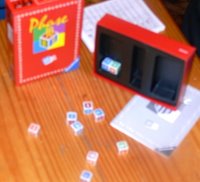
Phase 10 - Ravensberger dice game

We have played a game of Phase 10, purchased for $15 at the game store in the Station Arcade in Adelaide's town centre. It is a simple dice rolling game where players take turns to make sequences of rolls of up to 10 dice (specially marked), generally attempting to make triplets, quadruplets and runs of numbers according to the requirements of the 'phase' they are in. The game contains a neat sturdy box, rules (not that easy to understand unless you like rules), a scorepad and ten dice. The dice are six sided, but contain numbers from 1 to 10 in different colours, and a number of 'W' faces which count as 'wild' scores).


There are ten phases in the game. Players take turns to try and roll a specified 'pattern' (eg three of a kind and a run of four consecutive numbers) in a total of three rolls of the dice before they hand the dice to the next player.

In the first and second rolls, the player chooses which (if any) dice they just rolled that they will roll again. A player can choose to leave some of the dice as they are, and use the face showing on these dice to count in their subsequent this turn. They must take the result of the third roll as final. If they don't make their Phase requirement (eg. seven consecutive numbers) for the phase they are in, play passes to the next player.If they make the requirement, they score each of the dice which is in the winning combination ...


... and record it.


When one player completes Phase 10, remaining players can try and pass through the remaining phases. They get three rolls as usual, per phase. If they don't make the requirement, they stop rolling and their game is over. If they make the phase requirement, they have three rolls at the next phase. This continues until they either complete Phase 10 or bomb out. The winner is the player on Phase 10 who has the most points.

Opinion: originally I was sceptical about a pure dice game. The game sucks you in, however, making choices about which dice to leave, which to reroll, which patterns to go for thereby, when to effectively surrender a turn to try for a better score, etc. In other words, you're mainly playing against yourself.

The game is produced by Ravensberger in the Czech Republic. Does that make it a "Eurogame"?
By the way, Jessica won.